
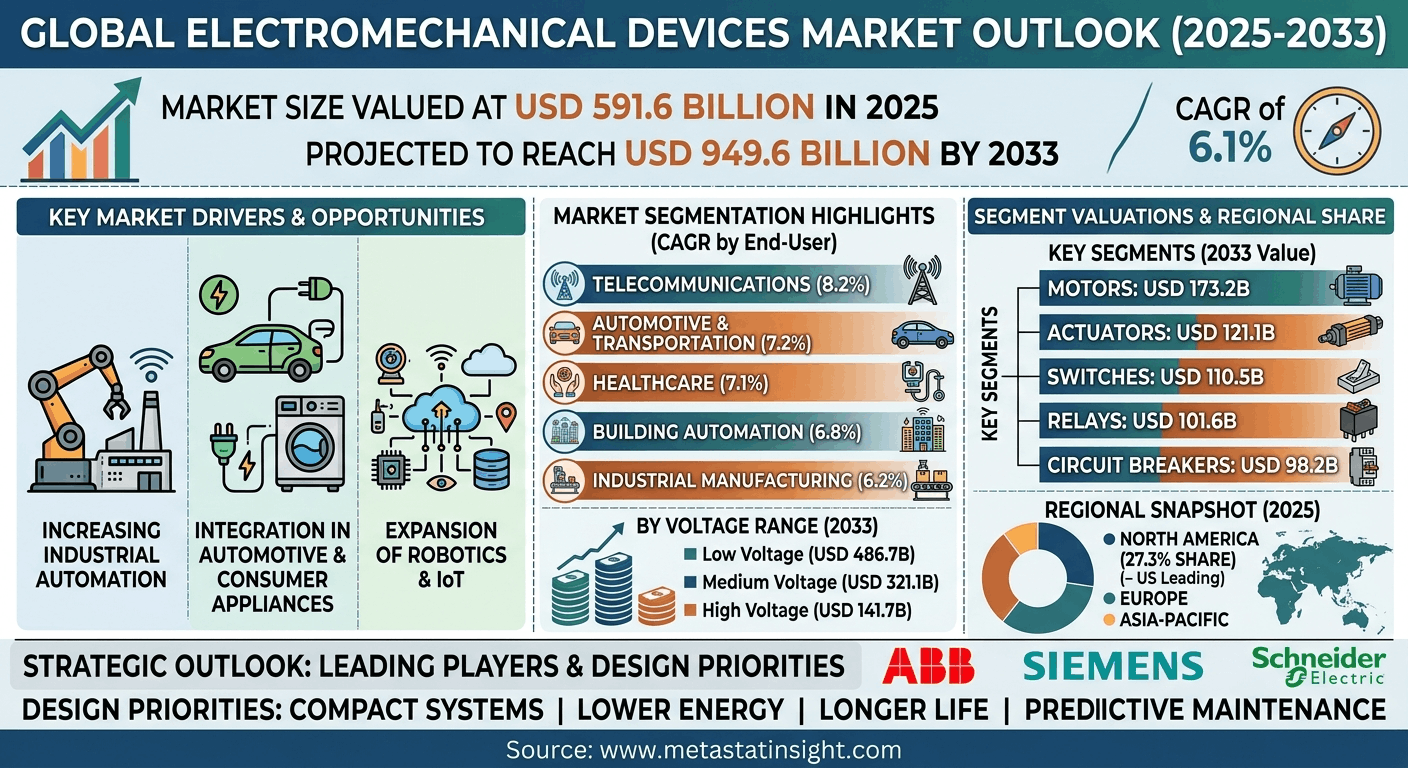
The Global Electromechanical Devices Market is experiencing significant growth momentum, driven by widespread industrial modernization, expanding automated systems, and a growing emphasis on product lifecycle reliability. According to a comprehensive research report published by Metastat Insight, the global market size is valued at USD 591.6 billion in 2025 and is projected to progress at a compound annual growth rate (CAGR) of 6.1% during the forecast period, ultimately reaching USD 949.6 billion by 2033.
Electromechanical devices serve an essential function across modern industrial operations by successfully converting electrical signals into precise mechanical motion while supporting critical switching, actuation, sensing, and motion control responsibilities. Because these hardware solutions deliver vital operational performance, they remain fundamental pillars inside modern household appliances, factory production machinery, transportation platforms, healthcare systems, and widespread energy management structures.
Key Market Drivers and Expanding Growth Channels
-
Surging Industrial Automation: The rapid transition toward factory modernization, smart manufacturing frameworks, and automated material handling configurations is notably increasing the demand for reliable motion control components, relays, actuators, and hardware assemblies. As global production hubs heavily prioritize continuous processing efficiency, manufacturing uptime, and energy savings, component procurement is seeing a steady upswing.
-
Electronics Integration in Automotive and Consumer Goods: The accelerating development of electric mobility, progressive driver-assistance layouts, connected appliances, and modern climate-control setups is creating stable demand for dependable positioning and switching operations. Manufacturers are answering this call with silent-operating, compact, and energy-conscious components built for user convenience.
Core Market Segment Highlights
-
By Type: The comprehensive analysis tracks several key component categories. The Motors segment stands strong with a valuation of USD 105 billion in 2026, forecasted to reach USD 173.2 billion by 2033 at a 7.4% CAGR. The Actuators segment exhibits high-speed growth, starting at USD 72.8 billion in 2026 and climbing to USD 121.1 billion by 2033 at a 7.5% CAGR. In terms of early market share, the Relays segment claims an established 13.3% share in 2025, valued at USD 83.3 billion in 2026 with a trajectory to reach USD 101.6 billion by 2033. Other foundational segments explicitly quantified through 2033 include Switches (reaching USD 110.5 billion), Circuit Breakers (reaching USD 98.2 billion), Electromechanical Sensors (reaching USD 98.6 billion), Contactors (reaching USD 85.4 billion), Solenoids (reaching USD 64.9 billion), and Encoders (reaching USD 61.1 billion).
-
By Voltage Range: Low Voltage applications lead the broader landscape and are expected to achieve USD 486.7 billion by 2033 due to extensive smart home, workplace, and telecom usage. Medium Voltage components are moving toward USD 321.1 billion by 2033, while High Voltage platforms support transmission networks to hit USD 141.7 billion by 2033.
-
By Sales Channel: Large-scale commercial execution keeps Direct Sales out in front, projected to hit USD 267.2 billion by 2033, closely supported by OEM Sales reaching USD 218.8 billion, Distributors and Dealers climbing to USD 214.2 billion, System Integrators expanding to USD 151.2 billion, and a fast-evolving B2B Online Sales channel touching USD 98.2 billion by 2033.
-
By End-User Industries: High-uptime applications across the Telecommunications industry are expanding at a leading CAGR of 8.2%, while Automotive and Transportation follows closely with a projected CAGR of 7.2%. The Healthcare sector is expected to rise at a 7.1% CAGR, and Building Automation is tracing a 6.8% CAGR. Industrial Manufacturing continues to demonstrate immense volume dominance across assembly line infrastructures, driving forward with a strong 6.2% CAGR over the forecast timeline.
Regional Demographics and Industry Landscape
Geographically, North America maintains an influential position, capturing a 27.3% market share in 2025, with the United States operating as the primary regional market leader due to EV manufacturing expansions, aerospace manufacturing strength, and automated factory upgrades. Europe shows a highly mature, technology-intensive market landscape shaped by rigorous safety certifications and active green energy transitions. Meanwhile, the Asia-Pacific region presents highly competitive supply chains and massive industrial capacity expansions, alongside rising equipment demand across developing South American, Middle Eastern, and African economic zones.
The competitive landscape features dominant global participants, including ABB Ltd, Siemens AG, Schneider Electric SE, Rockwell Automation, Inc., and Emerson Electric Co., alongside focused hardware innovators such as Eaton Corporation plc, Honeywell International Inc., Mitsubishi Electric Corporation, OMRON Corporation, Panasonic Industry Co., Ltd., and TE Connectivity plc. Contract wins over the coming decade will be strongly determined by specialized design engineering capabilities, rapid order lead times, local product availability, and built-in predictive maintenance compatibility.
About Metastat Insight
Metastat Insight is a premier global market research and consulting firm dedicated to providing comprehensive, data-driven market analysis and strategic outlook reports across diverse industrial sectors. By tracking key growth drivers, shifting market dynamics, and regional opportunities, Metastat Insight empowers organizations to make well-informed, long-term procurement and development decisions.