
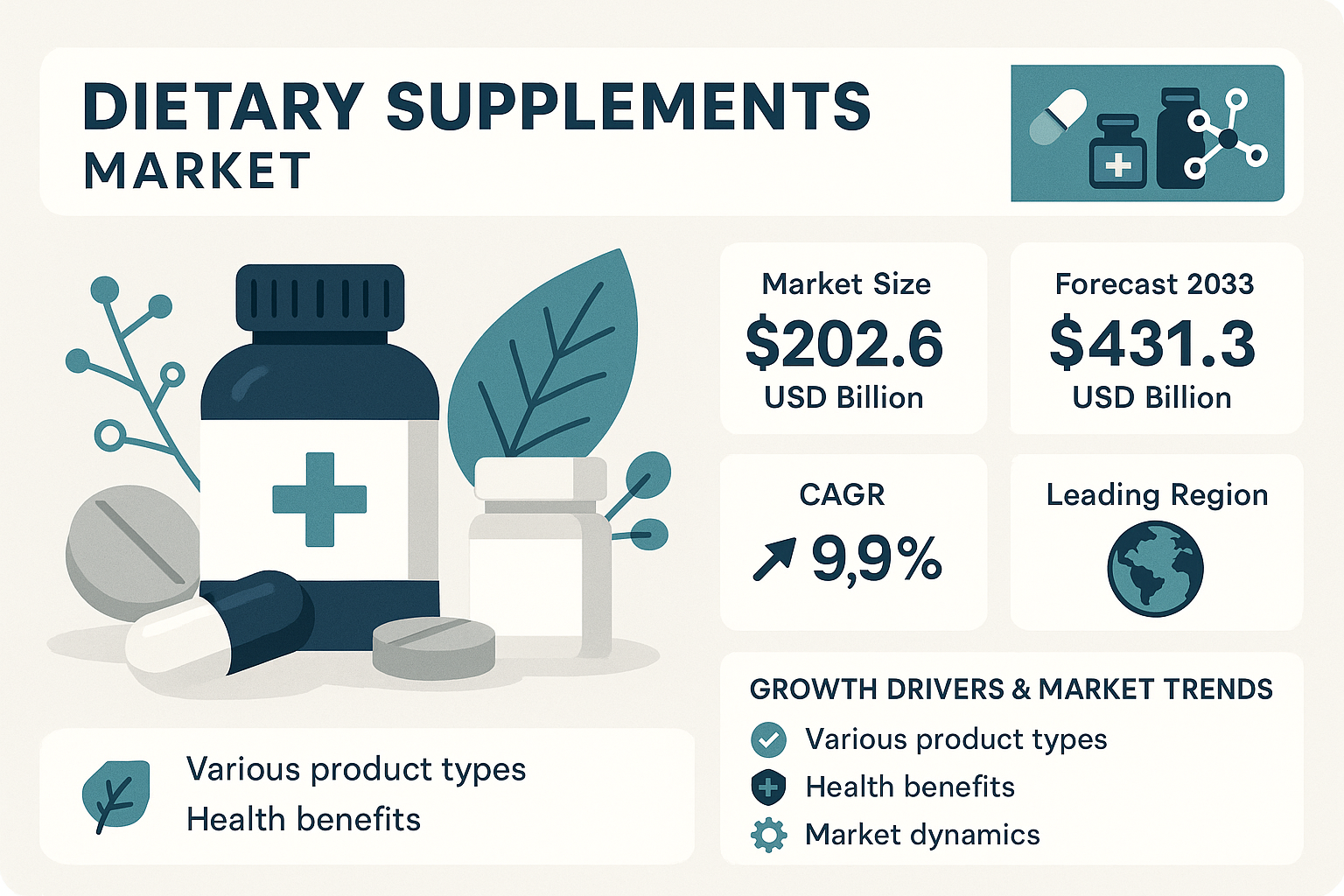
Metastat Insights has released a comprehensive report on the Dietary Supplements market, forecasting growth from USD 202.6 billion in 2025 to USD 431.3 billion by 2033, at a CAGR of 9.9%. The report covers various product types, health benefits, and market dynamics.
Metastat Insights has published "Global Dietary Supplements Market Size, Share, By Product Type (Vitamins, Minerals, Herbal and Botanical Supplements, Protein and Amino Acid Supplements, Probiotics, Prebiotics and Digestive Health Supplements, Omega Fatty Acid Supplements, Collagen and Beauty Supplements), By Form (Tablets and Capsules, Gummies and Chewables, Powders, Softgels, Liquids, Drops and Sprays, Functional Foods and Fortified Confectionery), By Health Benefit (General Wellness and Immunity, Digestive and Gut Health, Sports Performance and Muscle Recovery, Bone and Joint Health, Beauty, Skin, Hair and Nails, Weight Management and Metabolic Health, Cognitive Health, Stress and Sleep), By Sales Channel (Pharmacies and Drug Stores, Supermarkets and Hypermarkets, Online Marketplaces and DTC Platforms, Health and Specialty Nutrition Stores, Practitioner and Direct Selling Channels), Industry Analysis, Growth, Trends, and Forecast, 2026-2033", reporting a market value of USD 202.6 billion in 2025, with projections reaching USD 431.3 billion by 2033, reflecting a compound annual growth rate (CAGR) of 9.9%.
What is driving Dietary Supplements demand?
Growing consumer awareness surrounding health and wellness significantly drives demand within the Dietary Supplements market. Factors including rising disposable income enable consumers to invest in health-related products. North America, holding a 35.9% market share in 2025, leads in this trend, with the United States expected to dominate in 2026. Concurrently, Europe remains a close contender with a share of 27.8%, where preventive healthcare continues to influence purchasing habits. The Asia Pacific region, accounting for 23.2%, benefits from rapid urbanization and lifestyle changes, enhancing demand for dietary supplements.
What is limiting growth in the Dietary Supplements market?
Regulatory compliance poses a significant challenge for the Dietary Supplements market, impacting product formulation, labeling, and advertisement practices. Increasing scrutiny from governments worldwide leads to higher operational costs, affecting manufacturers' pricing strategies. Macroeconomic factors including inflation and rising material costs further strain profit margins, compelling companies to delay product launches or scale back innovation. Geopolitical instability disrupts supply chains, complicating the sourcing of raw materials and affecting product availability.
Market segmentation and regional analysis
The Dietary Supplements market is segmented by product type, form, health benefit, and sales channel. Product types include vitamins, minerals, herbal supplements, protein supplements, probiotics, and omega fatty acids, among others. The vitamins segment alone is projected to grow from USD 65.9 billion in 2026 to USD 118.6 billion by 2033, with a CAGR of 8.8%. Regionally, North America leads, followed by Europe and Asia Pacific, while South America and the Middle East and Africa account for smaller shares. This segmentation allows companies to tailor products to specific consumer needs and preferences.
Key players in the Dietary Supplements market
The competitive environment of the Dietary Supplements market features numerous players striving for market share. Notable companies include Nestlé Health Science, Bayer, Herbalife, and Amway, each implementing strategies to enhance their market position. Ongoing mergers and acquisitions further shape the competitive environment, allowing firms to expand their portfolios and enhance reach. This dynamic environment emphasizes the importance of innovation and sustainability, because companies seek to meet evolving consumer preferences.
For further insights and detailed analysis, the full report is available at Global Dietary Supplements Market.