
The structural framework of global renewable energy infrastructure is undergoing a significant transformation. According to the comprehensive data-driven industry evaluation published by MetaStat Insight, the global Concentrated Solar Power (CSP) Market size is officially valued at USD 7.5 billion in 2025. Sparked by an accelerating transition toward fully decarbonized electrical networks, the sector is projected to expand at a Compound Annual Growth Rate (CAGR) of 11.1% during the multi-year forecast window, culminating in an industry valuation of USD 17.3 billion by the year 2033.
Thermal Energy Storage Emerges as the Compelling Operational Advantage
The global market is gathering massive operational momentum as utility corporations look past traditional intermittent resources toward baseline-capable green energy alternatives. Unlike standard solar photovoltaic (PV) systems, concentrated solar power technology deploys highly accurate configurations of specialized mirrors and lenses designed to track and focus natural sunlight. This captured solar concentration generates intense thermal energy, which can be efficiently reserved within molten salt infrastructure and subsequently translated into continuous, reliable electricity long after sunset.
Integrating thermal energy storage has established itself as the definitive competitive advantage of modern CSP installations, enabling operators to achieve the critical objective of delivering round-the-clock renewable electricity to heavy grids. This flexibility answers systemic concerns regarding macro-level carbon footprint reductions, long-term grid stability, and structural fuel diversification. As a result, global governments and major utility developers are scaling up capital deployments toward substantial, utility-scale CSP installations, industrial heat systems, and regional desalination infrastructure.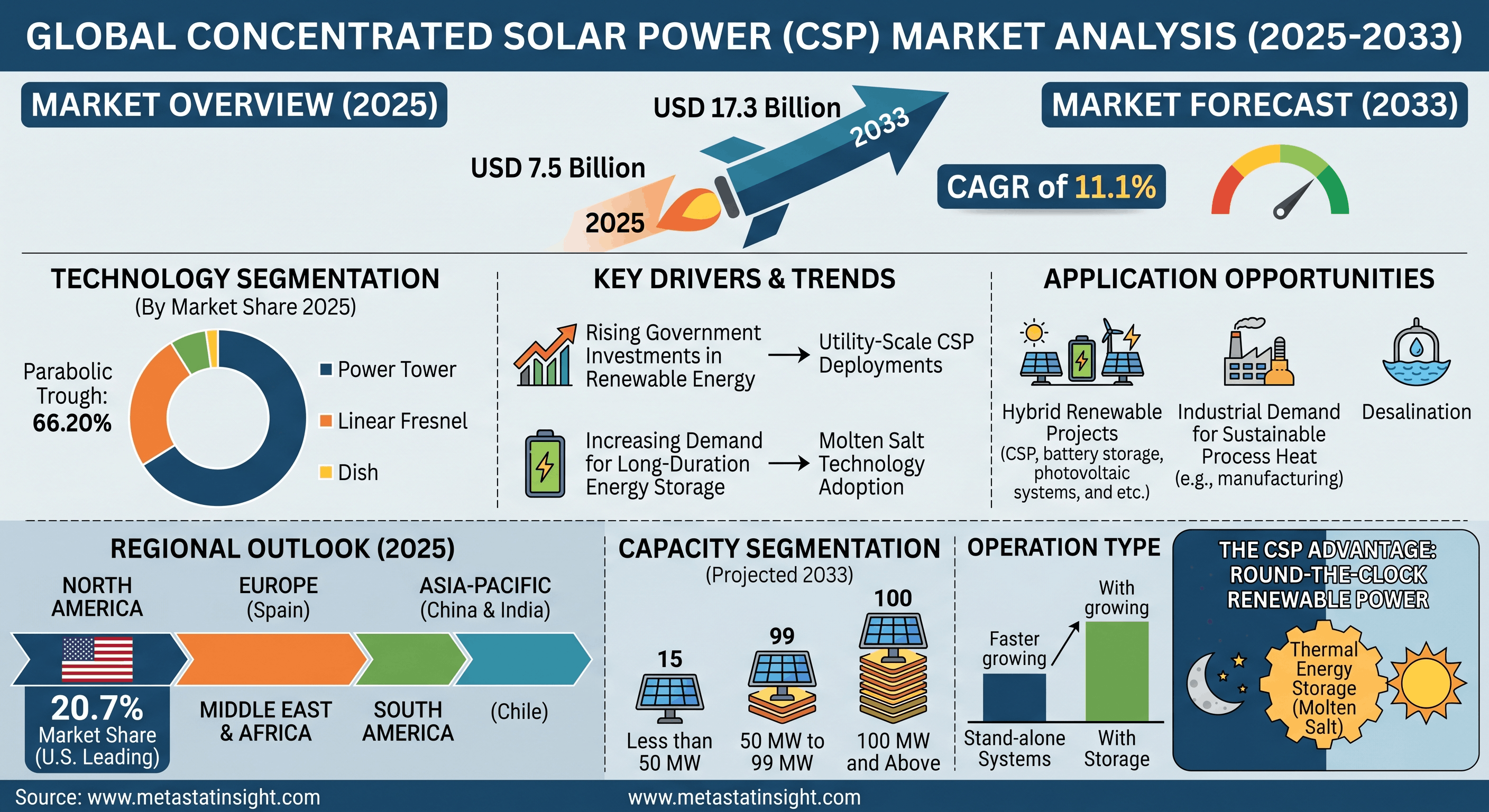
Technology Framework & Application Segments
The technological architecture of the Concentrated Solar Power market is segmented into distinct variations, including Parabolic Troughs, Linear Fresnel systems, Dish configurations, and Power Towers:
-
Parabolic Trough: Valued at USD 5.4 billion in 2026, this technology continues to command the largest market footprint, tracking toward USD 10.2 billion by 2033 at a steady 9.5% CAGR due to its reliable thermal generation and advanced tracking capabilities. It held a dominant 66.20% market share in 2025.
-
Power Tower: Representing the fastest-growing technology architecture, this segment is valued at USD 2.1 billion in 2026 and is projected to reach USD 5.4 billion by 2033 at a rapid CAGR of 14.3%.
-
Linear Fresnel & Dish Systems: These niche segments are projected to hit USD 1.3 billion and USD 0.4 billion by 2033, respectively, answering distinct industrial and remote operational needs.
Based on operational applications, the Utilities segment continues to lead the industry, tracking toward a USD 14.5 billion valuation by 2033 at an 11.4% CAGR due to rising baseline electricity consumption. Environmental integration is also expanding across specific industrial sectors, such as Desalination (heading to USD 1.0 billion by 2033 at a fast 15.1% CAGR) and Enhanced Oil Recovery (EOR) (looking toward a USD 1.1 billion valuation by 2033).
Geographic Landscape: Regional Growth Engines
Geographically, North America represents a solid 20.7% market share in 2025, backed by robust clean energy targets and federal tax credits within the United States. In Europe, Spain maintains a leading role, using advanced storage setups to advance carbon neutrality goals. The Asia-Pacific region is positioned for significant growth, with China funding large-scale power tower systems and India ramping up installations to handle expanding domestic energy demand. Meanwhile, rich solar resource profiles in the Middle East and Africa are fueling dual-purpose utility and desalination plants.
About MetaStat Insight
MetaStat Insight is a premier global market research and strategic consulting firm. We specialize in providing comprehensive, data-driven market analysis, competitive benchmarking, and forward-looking strategic outlooks across specialized industrial sectors.