
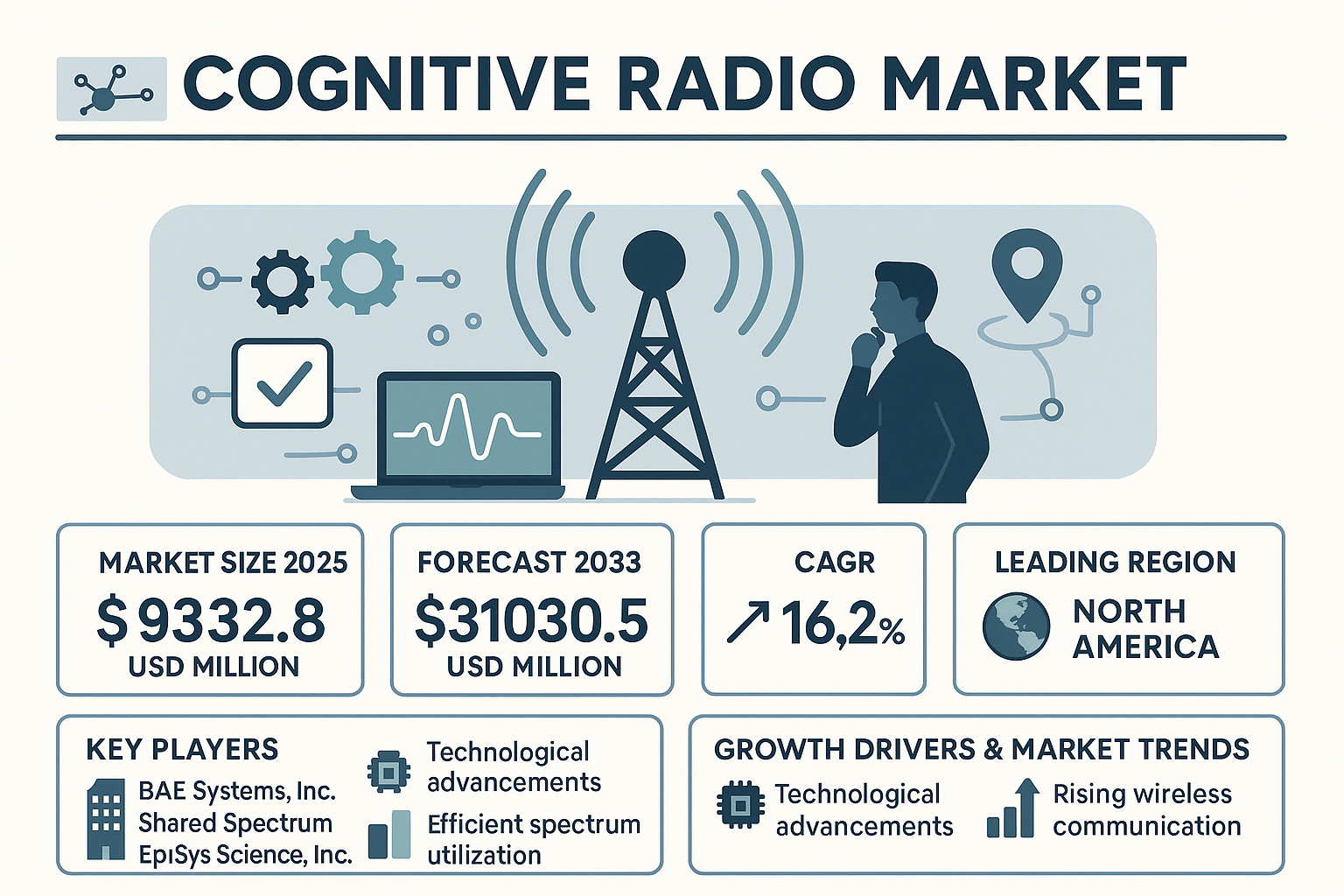
Metastat Insights reveals the Cognitive Radio market will grow from USD 9,332.8 million in 2025 to USD 31,030.5 million by 2033, at a CAGR of 16.2%.
Metastat Insights has published "Global Cognitive Radio Market Size, Share, By Component (Hardware, Software and Services), By Application (Cognitive Routing, Location Tracking, Spectrum Allocation, Spectrum Analysis and Spectrum Sensing), By End Use (Government & Defense, Telecommunication and Transportation), Industry Analysis, Growth, Trends, and Forecast, 2026-2033". The Cognitive Radio market was valued at USD 9,332.8 million in 2025 and is anticipated to reach USD 31,030.5 million by 2033, reflecting a compound annual growth rate of 16.2%.
What is driving Cognitive Radio demand
Growth in the Cognitive Radio market is significantly driven by advancements in wireless communication technology along with the rising demand for effective spectrum management. North America is expected to account for 36.7% of the market share in 2025, with the United States leading in 2026 owing to its well-established telecommunications infrastructure and substantial investments in research and development. Following closely, Europe holds a 24.8% market share, focusing on regulatory compliance and fostering innovation in cognitive radio applications. Meanwhile, the Asia Pacific region, comprising 27.5% of the market, sees robust growth fueled by rapid urbanization and substantial investments in cognitive radio technologies from nations like China and India.
Challenges impacting the market
Multiple challenges hinder the Cognitive Radio market's growth trajectory. Regulatory constraints across various regions impose compliance burdens that require significant time and financial resources from manufacturers and service providers. Macroeconomic pressures, including inflation and increasing raw material costs, affect capital allocation strategies, making investments in new technologies less appealing. Geopolitical tensions and trade disputes disrupt supply chains, resulting in heightened operational costs and delays in product development timelines. These dynamics compel companies to navigate complex regulations while adapting to evolving market conditions.
Market segmentation and regional analysis
The Cognitive Radio market is categorized by component, application, and end use. Each category plays an essential role in shaping market dynamics. By component, hardware, software, and services are critical, with the hardware segment projected to grow from USD 5,211.3 million in 2026 to USD 13,653.4 million by 2033. The demand for software solutions is expected to push the segment to reach USD 11,791.6 million by 2033, driven by the need for efficient spectrum management across diverse sectors. In terms of applications, significant demand arises from cognitive routing and spectrum allocation, reflecting the growing necessity for dynamic frequency management. Key geographical regions, including North America, Europe, and Asia Pacific, each contribute uniquely to the overall growth of the market.
Competitive landscape in the Cognitive Radio market
The competitive environment within the Cognitive Radio market is characterized by fragmentation, with numerous players working towards innovation and strategic partnerships. Key participants, including BAE Systems, Inc., RTX Corporation, Thales Group, and L3Harris Technologies, emphasize enhancing their market positions through technological improvements. This competitive setting fosters ongoing product and service innovations that ultimately benefit end users in sectors including government, telecommunications, and transportation. Investment in research and development remains essential for companies seeking to meet evolving customer needs and adhere to regulatory requirements.
For further insights and comprehensive analysis, readers access the full report at Global Cognitive Radio Market.