
Comprehensive architectural industry intelligence compiled by MetaStat Insight indicates a profound structural transition underway within the Oceania financial ecosystem. The newly unveiled strategic publication reveals that the Australia Parametric Insurance Market size is valued at USD 286.4 million in 2025. Bolstered by shifting environmental dynamics and operational optimization, the industry is projected to advance at an aggressive compound annual growth rate (CAGR) of 12.2% during the subsequent assessment timeline, arriving at an industry valuation of USD 720.9 million by 2033.
According to the analysis, this expansion reflects a crucial evolution where index-triggered coverage frameworks are successfully migrating from specialized niche solutions into mainstream corporate and institutional risk-management toolkits. This shift is primarily fueled by escalating climate anomalies across the Australian geography encompassing bushfires, intense flooding, severe cyclones, and protracted droughts which continue to highlight the fundamental operational and payout latency constraints associated with historic indemnity-based coverage plans.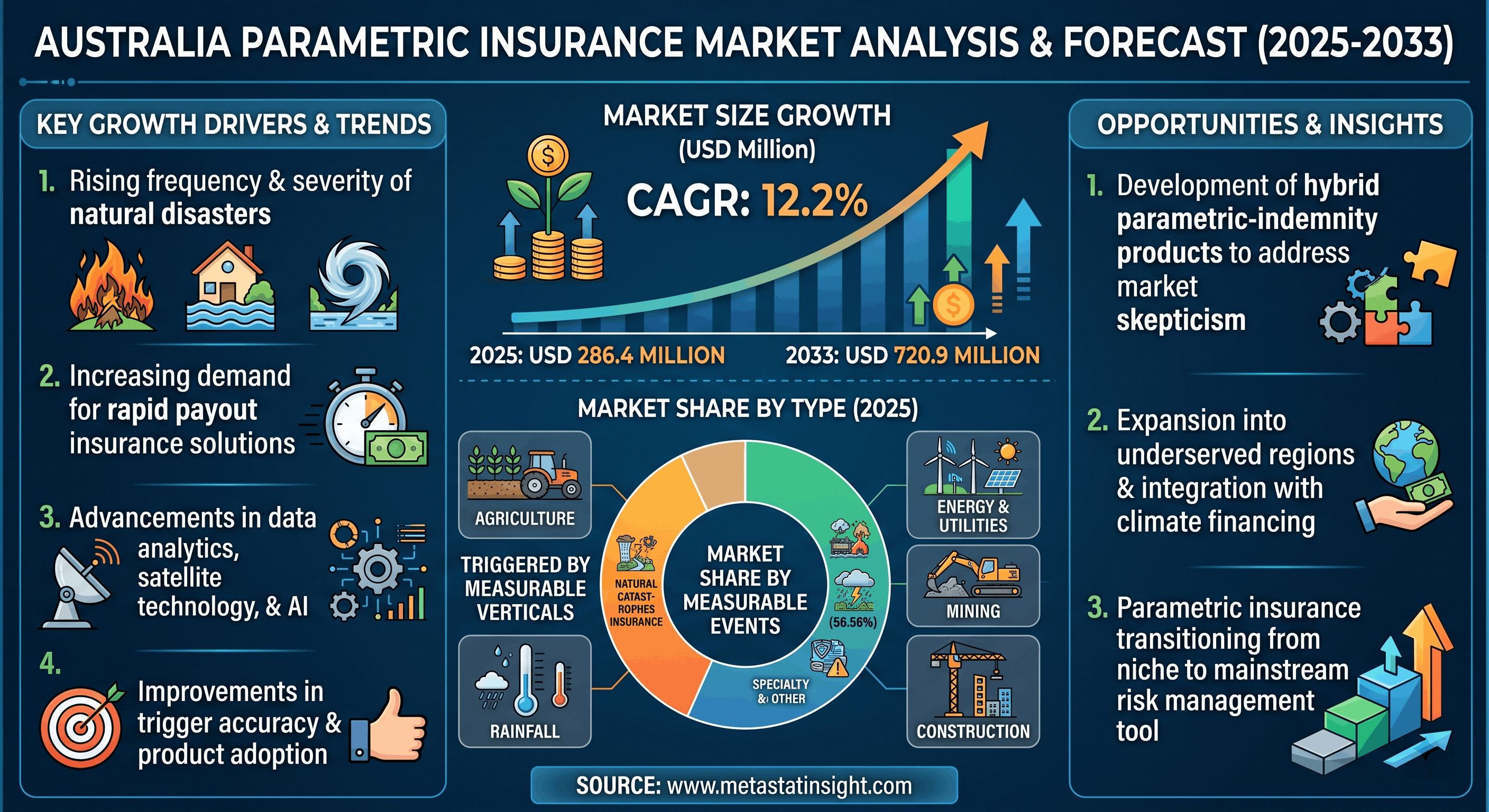
Primary Market Triggers and Data Innovations
The rapid deployment of parametric structures across the continent is tightly correlated with two primary market drivers outlined in the intelligence report:
-
Escalating Weather Volatilities: The compounding occurrence and commercial intensity of localized natural catastrophes across public infrastructure, regional enterprises, and commercial developments have intensified the institutional requirement for rapid capital deployment solutions. Trigger-based structures automate financial assistance, facilitating immediate recovery initiatives.
-
Technological Convergence: Unprecedented breakthroughs in predictive analytics, satellite tracking networks, and artificial intelligence models have substantially upgraded baseline trigger configuration metrics. This technological refinement fosters deeper underwriting transparency, lowers historical contract disputes, and solidifies market trust.
Structural Limitations and Systemic Hurdles
Despite a highly constructive forecast, MetaStat Insight underlines critical operational hurdles that market participants must systematically navigate to maintain long-term stability:
-
Basis Risk Management: A persistent challenge remains centered on basis risk the inherent potential for a mismatch between verified field losses and predefined sensor-payout triggers. Mitigating this discrepancy via accurate mathematical calibration is critical to preserving policyholder credibility.
-
Data Calibration and Standardization: Product scaling is currently hindered by fragmented historical data frameworks and localized record variances. Eliminating these data limitations through integrated data-sharing arrangements and shared evaluation standards remains a prerequisite for optimized premium valuation models.
Strategic Alliances and Forward Prospects
The competitive horizon highlights a symbiotic mix of analytical boutiques, regional distribution brokers, and tier-one global reinsurance networks. Innovators like CelsiusPro and Descartes Underwriting continue to deliver advanced algorithmic risk modeling and data-centric solutions, while dedicated broking systems such as Epsilon Insurance Broking Services Pty Ltd and specialized weather entities like MSI GuaranteedWeather, LLC build critical transactional trust.
Concurrently, global market operators including Swiss Re Group, Munich Re, AXA XL, Chubb Limited, Liberty Mutual Insurance, Allianz Group, alongside advisory networks like Guy Carpenter & Company, LLC and Aon plc are injecting profound risk capability and underwriting capacity into the ecosystem. The evolving emergence of hybrid parametric-indemnity risk models is expected to further dismantle historical buyer resistance, bridging the gap between automated velocity and exhaustive indemnity validation.