For stakeholders, investors, and supply chain managers, understanding the dynamics of this expansion is critical. The integration of robotics and artificial intelligence is no longer a futuristic concept but a baseline requirement for competitive industrial production.
Here are the defining trends shaping the advanced manufacturing and industrial robotics market in 2026.
1. Accelerated Adoption of Automation and Robotics
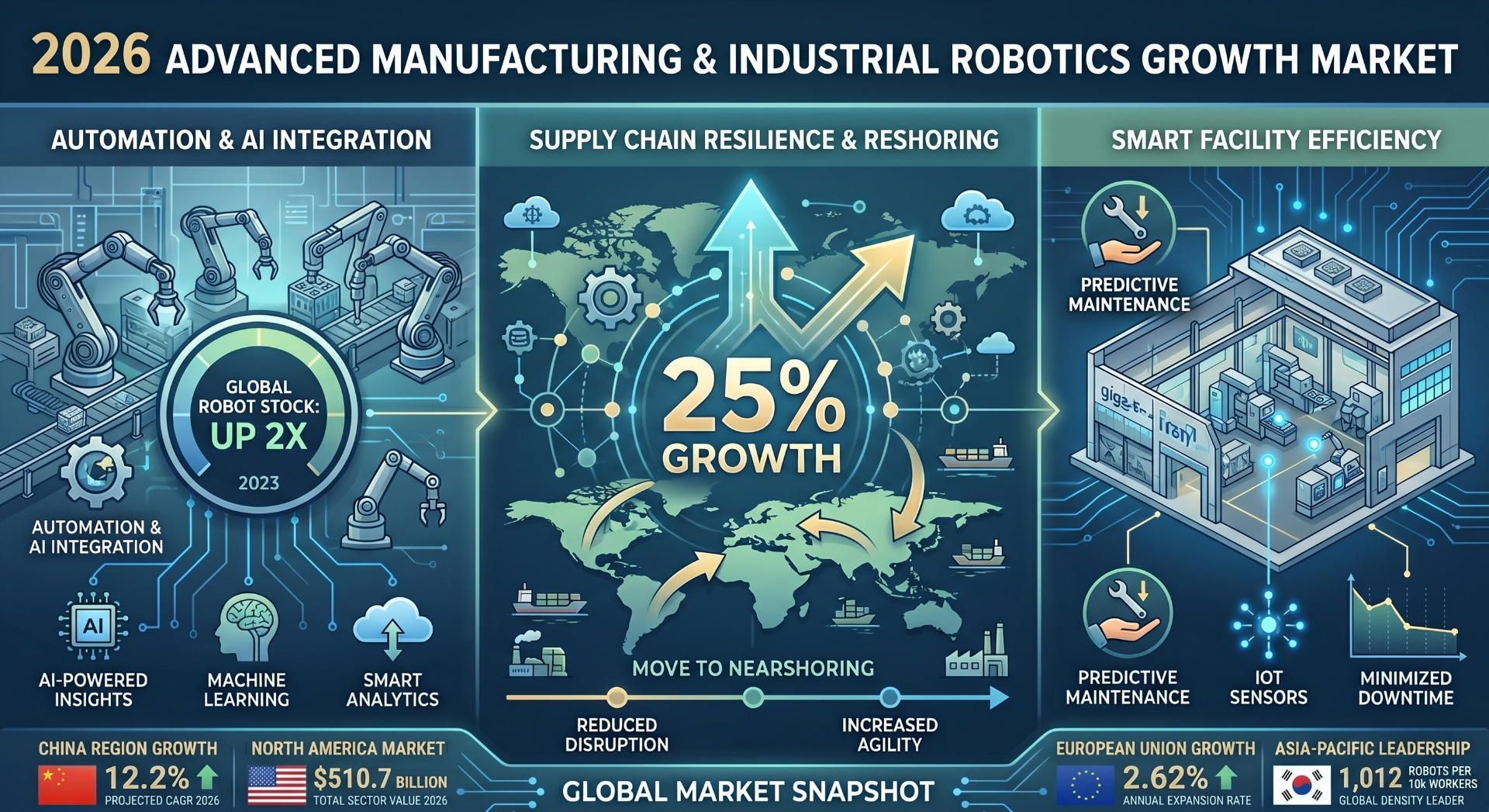
The surge in advanced manufacturing is heavily fueled by automation, robotics, artificial intelligence, and the rise of smart supply chains. Industrial robotics has grown into a massive B2B business, extending its reach beyond traditional factories into agriculture and medical settings.
Historically, the scale of this adoption has been staggering. For context, the global stock of industrial robotics reached 3.9 million units in 2023, and that number is slated to climb significantly higher in 2026. Regional dominance remains a key factor in this market; for example, China installed a record 290,258 industrial robots in 2022, capturing 52% of the global market at that time.
2. The Shift Toward Reshoring and Nearshoring
Global supply chain disruptions over the past few years have forced a massive strategic pivot. In 2026, companies are actively adopting reshoring and nearshoring models to enhance their overall resilience.
-
Operational Agility: By reducing dependency on distant suppliers, manufacturers are gaining greater operational flexibility.
-
Digital Integration: Production systems are becoming increasingly digital, connected, and transparent. This allows manufacturers to respond rapidly to shifting market changes and customer expectations.
3. Data-Driven Smart Facilities
The deployment of industrial robots goes hand-in-hand with data analytics. Modern facilities are leveraging real-time data to predict maintenance needs, reduce downtime, and optimize energy consumption. The convergence of hardware (robotics) and software (predictive analytics) is creating smart factories that operate with unprecedented efficiency.
Market Insight: As the sector expands, the companies capturing the most market share are those that seamlessly integrate their hardware solutions with intuitive, data-driven management software.